


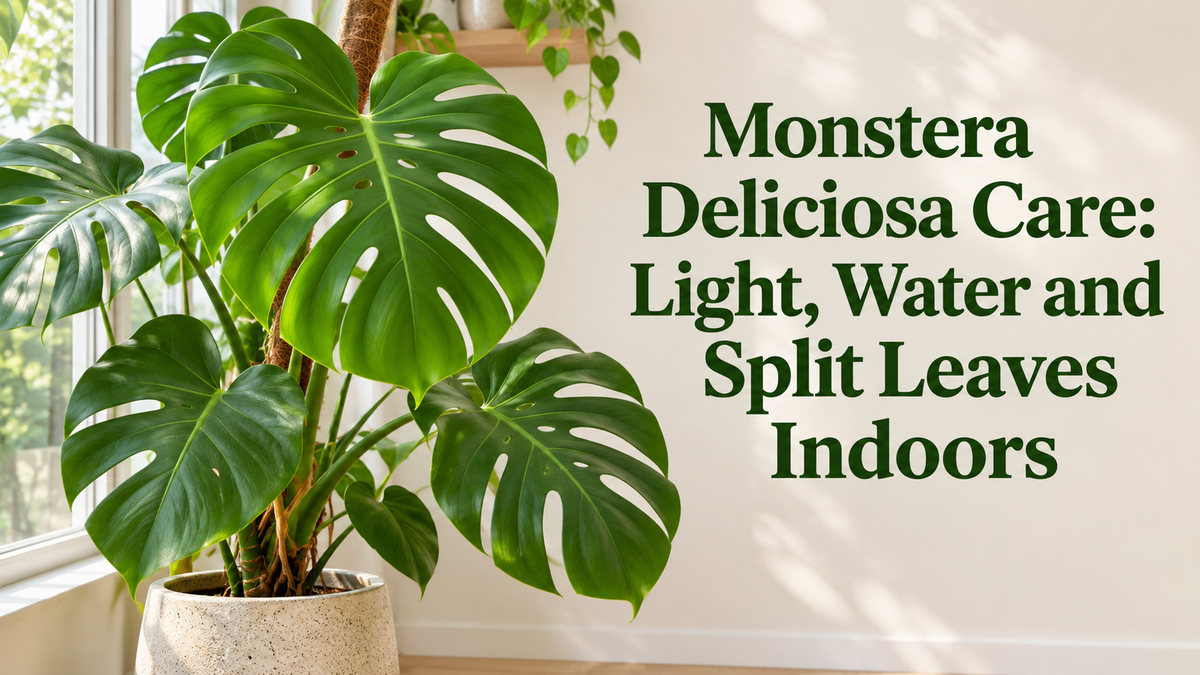
Monstera deliciosa care works best when you match the plant to a bright spot, let the upper soil dry between waterings and give its stems something to climb.
This Swiss cheese plant comes from southern Mexico and Central America, where it grows upward toward brighter forest light.
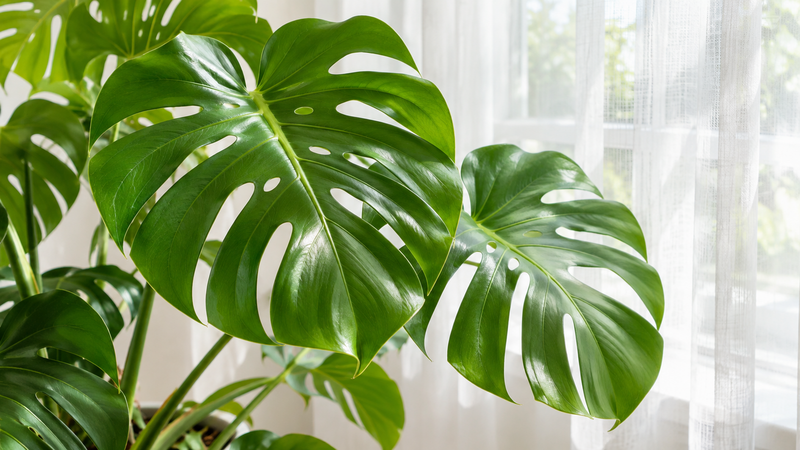
Young leaves are solid and heart-shaped; mature growth develops splits and holes.
A healthy plant needs time to change, and good monstera deliciosa care influences future leaves rather than adding splits to foliage already open.
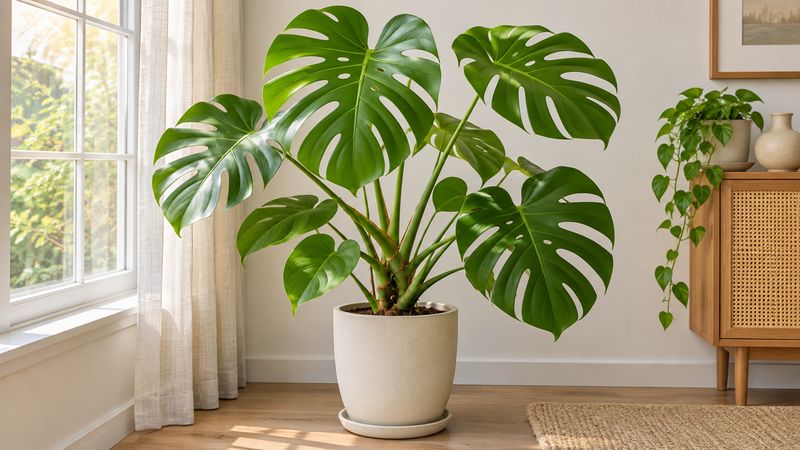
Monstera Deliciosa Care at a Glance
Use this table as a quick reference. The sections below explain each point in more detail.
| Care point | What to do |
|---|---|
| Light | Bright indirect light, about 6–12 hours each day |
| Water | Water when the top 1–2 in (about 3–5 cm) is dry |
| Soil | Chunky aroid mix with drainage holes |
| Temperature | 18–27°C (65–80°F); keep above 13–15°C (55–59°F) |
| Humidity | 40–60% is fine; 50% or more is better |
| Feeding | A balanced houseplant feed at half strength in spring and summer |
| Support | Moss pole, coir pole or trellis |
| Repotting | Every 12–24 months |
| Pet safety | Toxic to cats and dogs |
For another indoor growing guide, see our Pothos Care article.
Bright Indirect Light Supports Strong Indoor Growth
A monstera grows best in bright indirect light. This is the condition that allows the plant to build large leaves without burning the tissue.
Place it near an east-facing window, where it receives gentle morning light. It can also sit a few feet back from a bright south- or west-facing window. A sheer curtain helps when direct sun reaches the leaves through those windows. In winter, when sunlight is weaker, closer placement is useful.
Bright light is one of the main aims of monstera deliciosa care. Low light slows growth and produces smaller leaves. Those leaves may stay plain and heart-shaped even on a healthy plant. The stem will also stretch toward the light, leaving long spaces between the leaves.
Harsh afternoon sun can cause brown, papery patches. These patches do not heal, so it is better to move the plant instead of waiting for damage to fade. The plant can take some morning sun because the light is softer at that time of day.
A north-facing window is often too dim for a monstera. It may survive there, but the growth will be slow and the leaves will not mature in the usual way.
Variegated types need even more light than green ones. Their white or cream areas have less pigment and therefore burn more easily. Put them in your brightest indirect spot, but keep them away from direct midday sun.
A simple shadow test helps. At midday, hold a hand about 10 cm (4 in) above the leaf. A crisp, defined shadow means the spot is bright enough. A faint shadow or little shadow at all suggests the light is weak.
Move the plant closer to the window if it is in a corner that only feels bright to the eye. A foot or two can make a real difference.
This balance is the reason why so many people search for monstera light requirements before moving a plant indoors.
Good monstera deliciosa care means treating light as the foundation of the plant’s size, leaf shape and growth rate.
For more indoor growing advice, browse our Indoor Plant Guides collection.
Soil Moisture Determines the Right Watering Interval
How often to water monstera is the question every owner asks. The answer is not a calendar — it is the soil. The soil should dry at the surface before you add water.
Push a finger into the top 1–2 in (about 3–5 cm). If it feels dry at that depth, water the plant. If it is still damp, wait and test again in a few days.
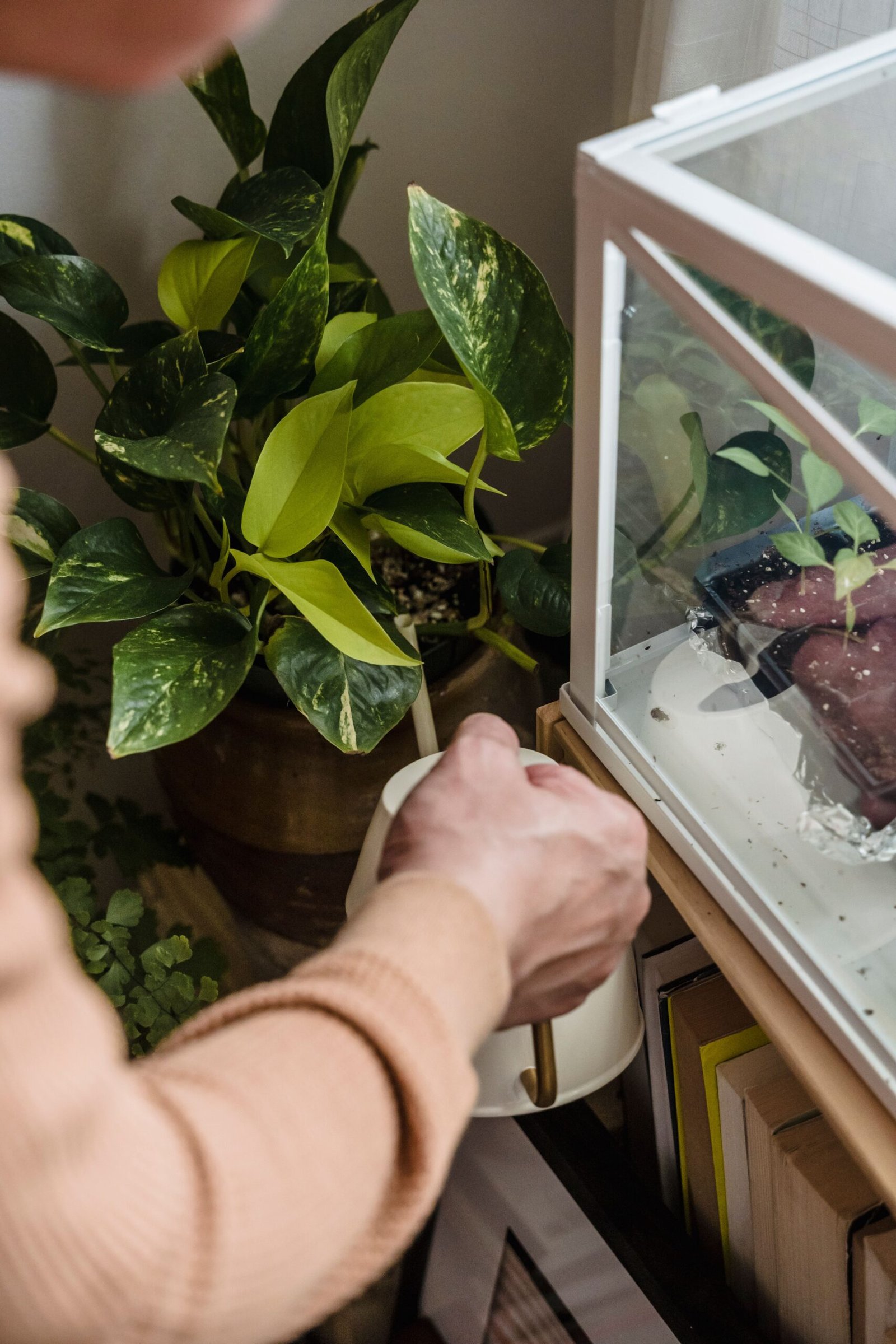
Water it thoroughly until water runs out of the drainage holes. Leave the water to drain, then empty the saucer so the pot does not sit in water.
With monstera deliciosa care, consistently wet roots are more damaging than a missed watering. A plant can recover from a single dry spell, but roots kept wet lose the air they need. They soften and can rot.
Root damage can follow. The plant may make yellow lower leaves, soft stems and a damp smell in the soil. When a plant stays wet for days, the soil is failing to drain and must be changed rather than watered less frequently.
Summer watering is usually about weekly, because the light is stronger and the plant is growing. Winter watering stretches to every two to three weeks because cold, low light and winter heating reduce growth.
The table gives a clear starting point, but the soil check decides.
| Season | Usual interval | What to check |
|---|---|---|
| Spring | Every 1–2 weeks | Top 1–2 in (3–5 cm) of soil is dry |
| Summer | Roughly every week | Top 1–2 in (3–5 cm) of soil is dry |
| Autumn | Every 2–3 weeks | Top 1–2 in (3–5 cm) of soil is dry |
| Winter | Every 2–3 weeks | Top 1–2 in (3–5 cm) of soil is dry |

In monstera deliciosa care, the pot, plant size and soil type all change how fast water is used. A small terracotta pot in a warm room dries faster than a large glazed pot away from a window. Summer heat increases water use, while a cool corner makes the mix stay damp longer.
If you have a variegated Thai or Albo monstera, remember that these grow more slowly than a green plant, so they use less water and are easier to overwater.
Use room-temperature water. Very cold water can shock the roots, and standing tap water or distilled water avoids the mineral build-up that clings to leaves.
Chunky Soil and Sensible Repotting Protect the Roots
A healthy monstera needs an airy soil mix. If the mix stays wet, the roots lack air and plant health declines.
Normal potting soil can hold too much water and quickly compact. This reduces the air pockets and makes it harder for the plant to grow strong roots. Use a chunky aroid mix instead.
The base of the mix holds moisture, while bark and perlite create air pockets and drainage. A handful of this mix should crumble after you squeeze it rather than staying in a tight ball.
Include this in monstera deliciosa care: aim for a pH of about 5.5–6.8, drainage holes in the pot and a mix with a visible texture rather than dense peat or plain soil.
Use the following recipe for most plants.
| Ingredient | Parts | Purpose |
|---|---|---|
| Potting mix or coir | 4 | Holds moisture and structure |
| Orchid bark | 3 | Creates air pockets and drainage |
| Perlite | 2 | Lightens the mix |
| Charcoal or worm castings | Small amount | Adds trace nutrients |
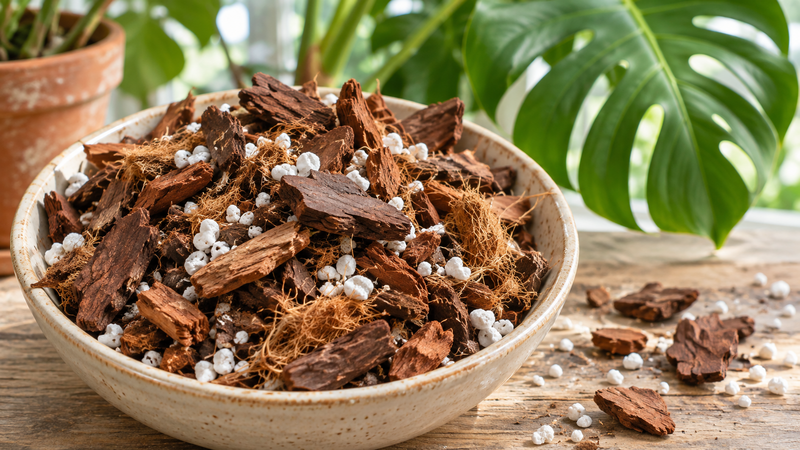
The exact ratio can vary a little. The important factor is a loose, open structure that water can pass through.
When you buy a bagged houseplant mix, check that bark and perlite are among the first few ingredients. A mix with those materials should feel light and chunky rather than fine and powdery.
The pot must have drainage holes. A pot without them holds water at the bottom after every watering. You can place the pot inside a decorative outer pot, but you must remove it after watering and drain the excess.
As part of monstera deliciosa care, repot the plant every 12–24 months, usually in spring. If roots circle the bottom or the mix stays wet for days, repotting is due. Slip the new pot over the old one to check the fit, then lift the plant out and shake off the loose soil.
Choose a new pot only one or two sizes wider than the old pot. This provides more room for growth without holding more water than the roots can use. The crown of the plant should sit at the same depth as before.
Water the plant a day or two before repotting. This makes the roots easier to handle and keeps the plant from drying out during the change. After repotting, water the plant lightly and let it drain.
Avoid moving a struggling plant into a new pot too quickly. A thirsty or damaged plant needs time to recover before it is disturbed again.
Warmth, Moderate Humidity and Gentle Airflow Reduce Stress
A monstera does best at room temperatures of 18–27°C (65–80°F). It should not be put in a cold draft, near an open window in winter or next to a heater.
Cold damage starts below about 13–15°C (55–59°F). At those temperatures the plant stops growing and the leaves can fade. If the temperature falls below that range, move the plant to a warmer room.
In monstera deliciosa care, warmth supports the growth of new leaves and prompts the plant to push out new leaves. Cold air puts a plant in a holding pattern and weakens its response to light.
Humidity of 40–60% is often fine for a monstera.
If the air is very dry, a humidifier or pebble tray under the pot can help. Group plants together so they share moisture. Humidity above 50% is better for larger leaves and fewer brown edges.
Misting alone is not enough to raise the humidity, though a gentle wipe of the leaves removes dust and helps them stay clean.
Air circulation matters in monstera deliciosa care too. A fan on a low setting and turned away from the plant helps fresh air move. An open window on a mild day can help. Stagnant air can encourage weak growth and fungal problems.
Avoid putting the plant where a fan or air-conditioning vent blows directly onto it. Constant airflow can dry out leaves and stems.
Stable Support Encourages Upright, Mature Growth
A monstera starts life on the forest floor and then climbs upward. Give the plant something to climb if you want large, mature leaves.
Support is part of monstera deliciosa care, and a pole helps the plant in more ways than one. It holds the stems in an upright position, guides new growth upward, and gives aerial roots a place to cling.
A moss pole suits most plants. It is a pole wrapped in sphagnum moss, which stays damp enough for roots to cling to. A coir pole is a similar choice. It is made of coconut fibre wrapped around a core. Avoid smooth wooden stakes because roots cannot grip them.
Start support early once the stems produce small knobby aerial roots. Push the pole into the soil at the base of the main stem at repotting time, so it has time to settle. Tie the stems loosely with soft ties or strips of cloth, leaving room for the stem to expand.
Tying the stems at intervals of about 10–15 cm (4–6 in) is usually enough, and you can add more ties as it grows. Push the stake firmly into the soil and then check that it does not sway or lean. A pole that leans after a few months can damage the plant.
Keep the pole moist. Mist it when you water or soak it lightly, and check the moisture a few centimetres below its surface.
A plant takes about 4–12 weeks to grip a new support. The pole should be about 30 cm (12 in) taller than the plant. Some owners start small and add an extension as the plant grows.
Guide the aerial roots towards the pole or into the soil. If a root is dried out, prune it gently from the main stem and let the plant focus on the roots that are staying damp. In monstera deliciosa care, healthy roots matter more than a tidy look.
New Leaves Develop Splits as Maturity and Conditions Improve
The question of why is my monstera not splitting usually has one of three answers: the plant is still too young, it is not getting enough light, or it has nothing to hold on to.
A plant needs to be about two to three years old before it begins to produce splits. The stem thickens and forms sturdy roots. The plant also needs to reach a certain size, with the first splits appearing in leaves at least 20–25 cm (8–10 in) wide.
Existing leaves never gain splits. This is a fixed rule in monstera care and no feeding, cutting or lighting can change it. Once a leaf is open, its shape is fixed. Only new leaves at the top of the plant can change as the plant matures.
Keep the plant close to an east window or close to a south- or west-facing window with a sheer curtain. If the plant is more than a couple of feet away from a window, it will still grow, but the light will not be strong enough to form splits.
Frequent use of a grow light can also help. A grow light positioned a couple of feet above the plant for 8–12 hours a day is one way to increase the daily light range.
A moss pole helps because the stem can climb, which is a cue that a plant has reached a mature form. It also helps a plant to grow more mature leaves.
Improvements in monstera deliciosa care show first in the size of the next leaf. The next leaf may develop slits on the edge first and then holes.
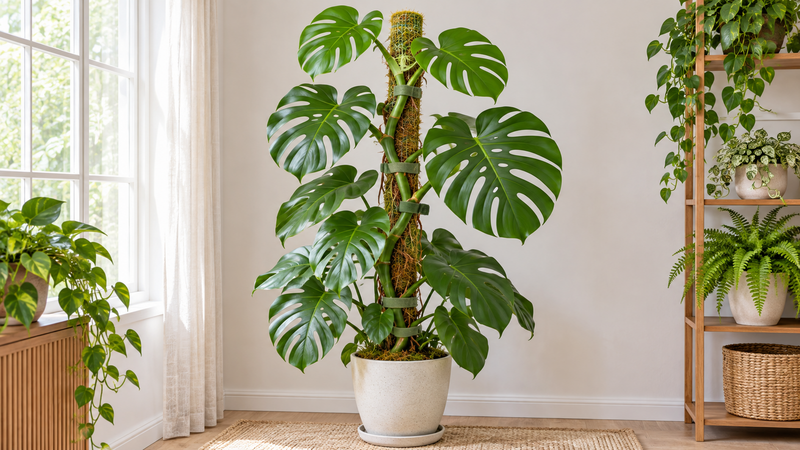
What delays splits
A plant kept in low light will make smaller leaves and show fewer signs of maturity. A trailing stem has less incentive to produce large leaves than one held upright. Poor watering also reduces the speed at which the plant changes. Strong, steady care gives a plant the best chance to reach mature form.
If a mature plant starts to produce plain leaves again, check for repotting damage, cold air or a move that has interrupted growth.
Some plants sold as monstera will never develop splits. Monstera standleyana and “Monstera Peru” are separate species that remain plain even when the care is good. Check the name on the label if you are looking for a split-leaf plant.
Leaf Changes Need a Soil Check Before Treatment
This is probably the most useful part of the article for a reader who can see that a plant is not well.
Practical monstera deliciosa care means pausing before you act. Check the soil moisture, drainage and the newest leaves first. The position of the plant and whether the damaged leaf is new or old also matters.
Table: Signs and likely causes
| Problem | Likely cause |
|---|---|
| One yellow lower leaf | Normal aging or a change in plant size |
| Several yellow leaves | Overwatering or wet soil |
| Yellow new growth with green veins | Iron or manganese deficiency with pH above 7.0 |
| Brown or papery patches on leaves | Sun scorch |
| Brown tips or edges | Low humidity, inconsistent watering, fertiliser salts or tap-water minerals |
| Soft, drooping stems | Overwatering or root rot if soil is wet; underwatering if soil is dry |
| Small leaves and no splits | Low light, young plant or no support |
| Long gaps between leaves | Low light |
| Stippled speckling and fine webbing | Spider mites |
| Silver or brown scars with black specks | Thrips |
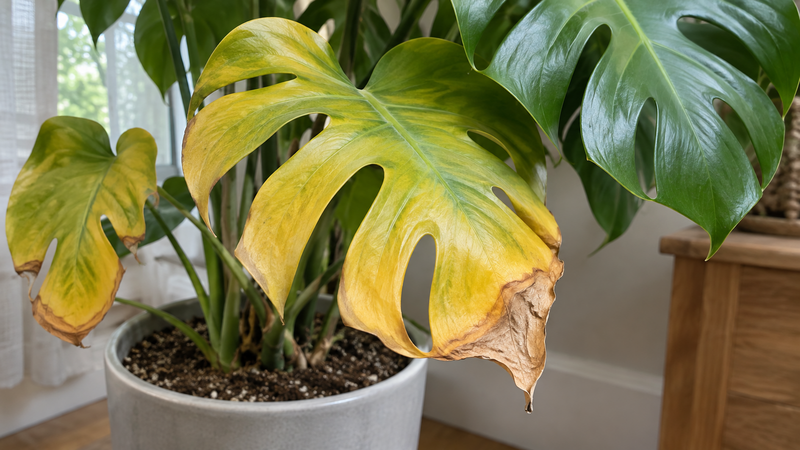
One yellow lower leaf is normal during growth. Several yellow leaves together with a wet pot is more serious. Take the plant out, check the roots and replace the soil with a fresh, loose mix.
If roots are mushy or black, cut the affected part off with clean scissors and repot it in fresh mix. Mushy roots do not recover, so it is better to remove them and let healthy roots take their place.
Yellowing, brown edges and wilted leaves can come from either dry roots or roots kept too wet. Start with the finger test. A dry pot will feel light, while a pot that stays wet will feel heavy.
Damaged yellow or brown tissue does not turn green again. Judge the recovery by the new leaves, not by the damaged ones.
Brown tips are usually caused by low humidity, uneven watering and mineral salts. Make sure the plant gets a consistent watering schedule. If tap water is to blame, let it stand uncovered for 24 hours, or use rain or distilled water.
Root rot is harder to diagnose than a single yellow leaf. If a plant has soft stems and a damp smell, the roots have a problem.
Pests can also produce symptoms that look like leaf damage. Spider mites can cause stippled bronze speckling and tiny webbing on the leaves. Thrips can leave pale streaks and silver-brown scars with black dots.
If a plant has a pest, it is better to use a gentle wash or treatment and give it time to recover.
For more watering and maintenance advice, browse our Plant Care collection.
Careful Pruning and Node Cuttings Shape Future Growth
Pruning controls the size and shape of the plant, and it is a normal part of monstera deliciosa care. It also supplies cuttings for new plants.
Cut above a node at a 45° angle for regrowth. Use clean, sharp bypass pruners, and wipe the blades between cuts with 70% isopropyl alcohol.
Prune at the start of the growing season, in spring or early summer. Take no more than a third of the plant at once. This limit keeps the plant from losing too many leaves at once.
Keep monstera deliciosa care gentle when you prune. A single cut can change the way a plant grows. Cutting the top encourages side shoots and makes the plant look fuller.
Remove long or damaged stems in small steps. Cut stems that are growing away from the light, or trim those that are blocking a window. Cut yellow or damaged leaves at the base of the stem.
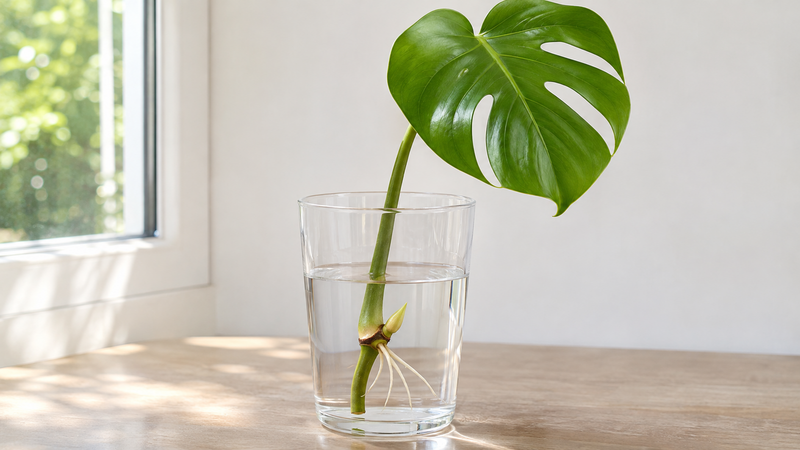
Take stem cuttings below a node
If you want a cutting, cut below a node. Make sure the cutting has at least one leaf and one node. The node is the small bump on the stem where a leaf or aerial root appears.
Place the cutting in water or moist mix, keep the node under water or in the mix, and change the water weekly. Roots usually appear in 2–4 weeks, and the cutting is ready to pot after roots are 2–3 in (5–8 cm) long.
A leaf without a node cannot grow into a new plant. A cutting with a leaf and a node is the reliable way to grow a new plant.
Guide aerial roots into the soil or around the pole. Do not remove them for a tidier appearance. They help the plant absorb moisture and nutrients.
Monstera Plants Belong Beyond the Reach of Pets
Monstera deliciosa is toxic to cats and dogs. The toxic principle is insoluble calcium oxalate crystals, also called raphides. They are needle-shaped crystals that cause pain and irritation inside the mouth.
Safe monstera deliciosa care includes keeping the plant out of reach. The ASPCA lists monstera as toxic to dogs and cats.
All parts of the plant are toxic when eaten, except for the fully ripe fruit. Signs of poisoning include intense burning of the mouth, tongue and lips, drooling, vomiting and difficulty swallowing.
A plant should be placed where pets cannot reach it. Height alone will not stop a cat, so block access to the plant or keep it in a closed room if necessary.
If a pet chews on part of the plant, remove any plant material from the mouth, offer water if it is safe to do so, and contact your vet or the ASPCA Animal Poison Control Center on (888) 426-4435.
Wear gloves when you handle the plant, especially when pruning. The sap can irritate skin.
If you are worried about your pet, check the ASPCA list of toxic plants for dogs and cats.
Frequently Asked Questions
How often should I water a Monstera?
Monstera deliciosa care follows soil moisture, not the calendar. Roughly every 1–2 weeks in spring or summer and every 2–3 weeks in winter works for many plants. Water only when the top 1–2 in (about 3–5 cm) of soil feel dry. Water thoroughly, let it drain and empty the saucer.
How much light does a Monstera need?
Give the plant bright indirect light for 6–12 hours a day. An east-facing window is a good choice, or place it a few feet back from a south- or west-facing window. Gentle morning sun is fine; harsh afternoon sun can scorch the leaves. A north window is usually too dim. Variegated types need the brightest indirect light and also burn most quickly.
Why is my Monstera not splitting?
Three things must line up: age, light and support. Splits appear at about 2–3 years, usually on a plant with about a dozen leaves and a thickening stem. A corner that feels bright may be too far from the window. Existing leaves never gain splits, and only new growth can change. Check the variety, because Monstera standleyana and “Monstera Peru” never develop splits.
What is the best soil for Monstera deliciosa?
Choose a chunky aroid mix with plenty of air in it. A potting or coir base with bark and perlite is a useful starting point, with a pH of about 5.5–6.8. The pot must have drainage holes, because no mix can save a plant in a sealed pot. Repot every 12–24 months in spring, one pot size up.
Is Monstera toxic to pets?
Yes. The ASPCA lists Monstera deliciosa as toxic to cats and dogs because of insoluble calcium oxalate crystals. If a pet chews the plant, the signs can include mouth irritation, drooling, vomiting and difficulty swallowing. Keep the plant out of reach and call your vet or the ASPCA Animal Poison Control Center on (888) 426-4435 if your pet has chewed part of it.
Sources: RHS and NC State Extension.

